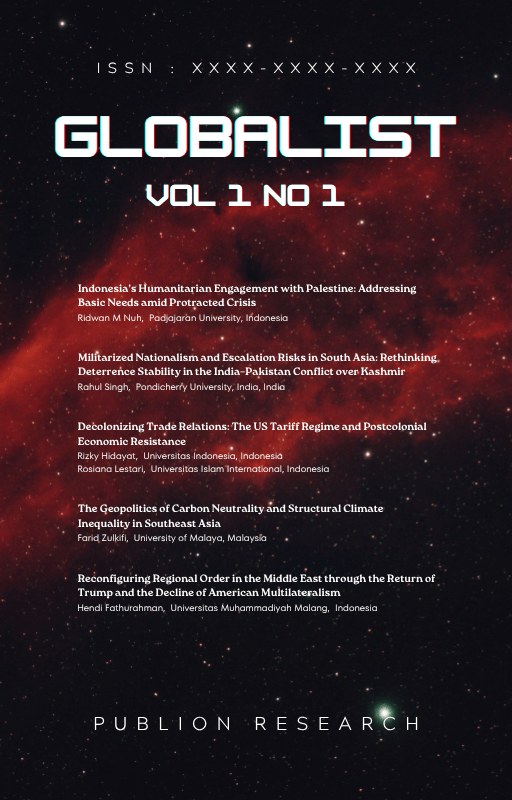
Militarized Nationalism and Escalation Risks in South Asia: Rethinking Deterrence Stability in the India–Pakistan Conflict over Kashmir
DOI:
https://doi.org/10.7080/xk14bj69Keywords:
Kashmir conflict, militarized nationalism, India–Pakistan rivalry, nuclear deterrence, strategic stabilityAbstract
This study examines how militarized nationalism and domestic political pressures in India and Pakistan disrupt classical deterrence theory and contribute to enduring strategic instability in the Kashmir conflict. By focusing on the interplay between ideological performance and crisis behavior, the research aims to critically reassess deterrence logic in a region marked by nuclear capabilities and political populism. The study employs qualitative content analysis and comparative case studies, using NVivo 14 software to analyze political speeches, military doctrines, and media narratives during high-intensity conflict episodes. Official documents, think tank reports, and peer-reviewed academic sources were reviewed to construct an integrated analytical framework grounded in international relations and political psychology. Findings indicate that both states routinely escalate conflict in pursuit of domestic legitimacy, often bypassing rational deterrence frameworks. Strategic signaling is distorted by ideological imperatives, and political leaders face internal constraints that limit their ability to de-escalate. As a result, the risk of miscalculation and uncontrolled escalation remains persistently high despite the presence of nuclear deterrents. This study is applicable to fields such as international relations, South Asian studies, strategic policy, and conflict resolution. It offers practical insight for policymakers, regional analysts, and scholars concerned with deterrence breakdown, nationalism, and inter-state rivalry under nuclear shadow. By integrating political ideology, institutional behavior, and public discourse into the study of deterrence, this research provides a new framework for understanding instability in South Asia. It advances existing scholarship by highlighting how domestic narratives of honor and identity can override strategic rationality and undermine peace-building efforts in nuclearized regional conflicts.
Downloads
References
Ahmad Dar, A., Deb, S., Thomas, S., Dhamodharan, M., Jahan, F., Sumaiya, B., & Gupta, S. (2023). Evidence and Predictors of Resilience among Young Adults Exposed to Traumatic Events of the Armed Conflict in Kashmir. Child and Youth Services, 44(1). https://doi.org/10.1080/0145935X.2021.1981133
Babar, S. I., & Mirza, M. N. (2021). The Indian Hybrid Warfare Strategy: Implications for Pakistan. Progressive Research Journal of Arts & Humanities (PRJAH), 2(1). https://doi.org/10.51872/prjah.vol2.iss1.22
Bashir, S. (2022). The China–India–Pakistan Nuclear Triangle: Consequential Choices for Asian Security. Journal for Peace and Nuclear Disarmament, 5(2). https://doi.org/10.1080/25751654.2022.2141053
Bharti, M. S. (2023). China’s Belt and Road Initiatives (BRI) in South Asia and Its Policy Challenges to India in the Region. South Asian Survey, 30(2). https://doi.org/10.1177/09715231231218827
Bhat, S. A. (2019). The Kashmir conflict and human rights. In Race and Class (Vol. 61, Issue 1). https://doi.org/10.1177/0306396819850988
Chaudhuri, R. (2019). War and peace in contemporary India. In Journal of Strategic Studies (Vol. 42, Issue 5). https://doi.org/10.1080/01402390.2019.1571414
Dar, A. A., & Deb, S. (2021). Mental Health in the Face of Armed Conflict: Experience from Young Adults of Kashmir. Journal of Loss and Trauma, 26(3). https://doi.org/10.1080/15325024.2020.1739367
Das, V., & Cook, M. A. (2023). India Ukre Giya: Loss and Change in Light of and in the Shadows of War. Journal of Sindhi Studies, 3(1). https://doi.org/10.1163/26670925-bja10013
Gabel, S., Reichert, L., & Reuter, C. (2022). Discussing conflict in social media: The use of Twitter in the Jammu and Kashmir conflict. Media, War and Conflict, 15(4). https://doi.org/10.1177/1750635220970997
Hassan, R. (2023). Journalism as profession helping women in conflict to move beyond victimhood discourse: A case study of Kashmir. Media, Culture and Society, 45(5). https://doi.org/10.1177/01634437231155795
Kazi, S. (2023). Conflict in Kashmir and Manipur: history, ethnicity, gender. Journal of Aggression, Conflict and Peace Research, 15(1). https://doi.org/10.1108/JACPR-01-2022-0667
Khan, M. N. (2024). Market volatility and crisis dynamics: a comprehensive analysis of U.S., China, India, and Pakistan stock markets with oil and gold interconnections during COVID-19 and Russia–Ukraine war periods. Future Business Journal, 10(1). https://doi.org/10.1186/s43093-024-00314-8
Khan, Z. (2022). The effects of US–China competing strategies in Asia-Pacific on India and Pakistan rivalry in the South Asian region. Asian Journal of Comparative Politics, 7(4). https://doi.org/10.1177/20578911211021155
Koul, R., & Bansal, G. (2023). Science teacher beliefs in conflict-affected zones of Jammu and Kashmir. Cultural Studies of Science Education, 18(2). https://doi.org/10.1007/s11422-023-10181-4
Menon, P. (2022). The China–India–Pakistan Nuclear Trilemma and Accidental War. Journal for Peace and Nuclear Disarmament, 5(2). https://doi.org/10.1080/25751654.2022.2134726
Mokhtar, S. (2020). Reading war photographs: the 1971 India–Pakistan war in the Anglo-American press. Visual Communication, 19(1). https://doi.org/10.1177/1470357219838602
Mukherjee, K. (2014). The South Asian Association for Regional Cooperation: Problems and prospects. Progress in Development Studies, 14(4). https://doi.org/10.1177/1464993414521524
Mukti, D. A., & Puspitasari, A. (2020). Dampak Konflik India-Pakistan di Wilayah Kashmir terhadap Stabilitas Keamanan Asia Selatan Pada Tahun 2016-2019. Balcony, 4(2).
Nurhidayat nurhidayat. (2023). Upaya Kelompok Ektrimis Untuk Menunggangi Isu Palestina-Israel: Analisis Diskursus Terhadap Narasi Kelompok Pro-Khilafah. IQTIDA : Journal of Da’wah and Communication, 3(1). https://doi.org/10.28918/iqtida.v3i1.342
Prott, V. (2023). ‘We have to tread warily’: East Pakistan, India and the pitfalls of foreign intervention in the Cold War. Cold War History, 23(1). https://doi.org/10.1080/14682745.2022.2102607
Qayyum, U., Anjum, S., & Samina Sabir. (2021). Armed conflict, militarization and ecological footprint: Empirical evidence from South Asia. Journal of Cleaner Production, 281. https://doi.org/10.1016/j.jclepro.2020.125299
Raja, S., Parvaiz, A., Sanders, L., Judelsohn, A., Guru, S., Bhan, M., Osuri, G., Tak, M., Mui, Y., & Frimpong Boamah, E. (2023). Planning and Food Sovereignty in Conflict Cities: Insights From Urban Growers in Srinagar, Jammu and Kashmir. Journal of the American Planning Association, 89(2). https://doi.org/10.1080/01944363.2022.2072370
Rizki, K., & Muquita, N. R. P. (2023). Analisis Pelanggaran Hak Asasi Manusia (HAM) Dalam Sengketa Wilayah Perbatasan Kashmir. Global Political Studies Journal, 7(1). https://doi.org/10.34010/gpsjournal.v7i1.9256
Shah, M. S., & Lala, M. F. (2021). Is the success of entrepreneurs dependent on the environment in a conflict zone: insights from Indian-administered Kashmir. Journal of Entrepreneurship and Public Policy, 10(4). https://doi.org/10.1108/JEPP-03-2021-0028
Shinta, T. (2020). Analisis Teori Fungsionalisme pada Integrasi Kawasan Asia Selatan (Studi Kasus Konflik India-Pakistan di wilayah Kashmir). Jurnal Sentris, 1(1). https://doi.org/10.26593/sentris.v1i1.4176.181-195
Shoib, S., & Yasir Arafat, S. M. (2020). Mental health in Kashmir: conflict to COVID-19. In Public Health (Vol. 187). https://doi.org/10.1016/j.puhe.2020.07.034
Sisson, R., & Rose, L. E. (2023). WAR AND SECESSION: PAKISTAN, INDIA, AND THE CREATION OF BANGLADESH. In War and Secession: Pakistan, India, and the Creation of Bangladesh. https://doi.org/10.2307/2759547
Tarapore, A. (2023a). Conditional restraint: Why the India-Pakistan Kargil War is not a case of nuclear deterrence. Bulletin of the Atomic Scientists, 79(6). https://doi.org/10.1080/00963402.2023.2266943
Tarapore, A. (2023b). Defence without deterrence: India’s strategy in the 1965 war. Journal of Strategic Studies, 46(1). https://doi.org/10.1080/01402390.2019.1668274
Thalpawila, O. N. (2022). Kashmir conflict: Yearning for an elusive peace in the contemporary South Asian Region. Acta Politica Polonica, 53. https://doi.org/10.18276/ap.2022.53-03
Yaseen, Z., Jathol, I., & Muzaffar, M. (2016). Pakistan and India Relations: A Political Analysis of Conflicts and Regional Security in South Asia. Global Political Review, 1(1). https://doi.org/10.31703/gpr.2016(i-i).01
Downloads
Published
Issue
Section
License
Copyright (c) 2025 Globalis: Journal of Global and Regional Politics

This work is licensed under a Creative Commons Attribution-ShareAlike 4.0 International License.