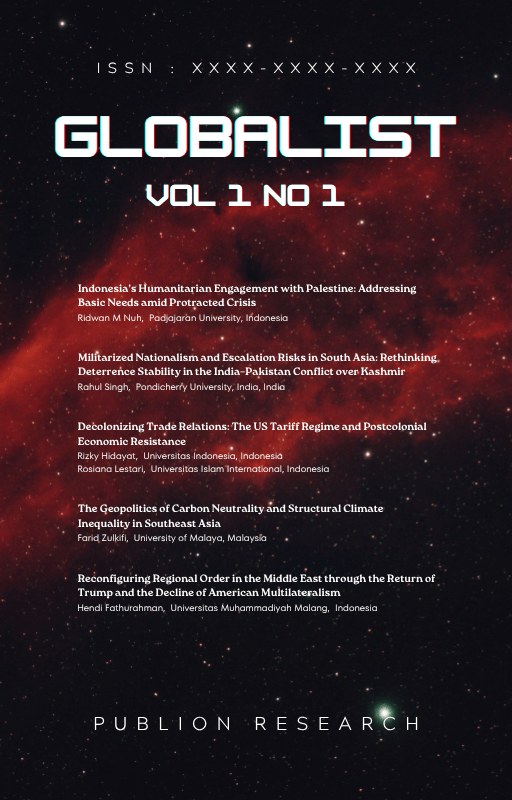
Decolonizing Trade Relations: The US Tariff Regime and Postcolonial Economic Resistance
DOI:
https://doi.org/10.7080/xdbje543Abstract
This paper investigates how the United States’ tariff regime continues to reflect structural features of colonial power in global economic relations. While often justified through narratives of national security, competitiveness, or trade fairness, contemporary U.S. tariff policies disproportionately target countries in the Global South, revealing an enduring pattern of economic coercion. By employing a postcolonial framework, the study argues that tariffs are not only tools of economic management but also instruments of strategic discipline that maintain asymmetric trade relations. The analysis draws on three case studies( India, Brazil, and South Africa) to show how these states have responded to U.S. trade pressures through a combination of legal contestation at multilateral forums, institutional innovation, and regional cooperation. These responses are interpreted not as isolated trade maneuvers, but as forms of postcolonial resistance that challenge the legitimacy of Western-dominated trade rules. Initiatives such as BRICS, the African Continental Free Trade Area (AfCFTA), and efforts toward de-dollarization are examined as expressions of trade sovereignty and epistemic realignment. The paper further explores how dominant economic theories and institutions reproduce the epistemic authority of the Global North while delegitimizing alternative models of development. In response, the article introduces the concept of a decolonial trade ethic, which emphasizes mutuality, historical accountability, and epistemic plurality in shaping future trade relations. This approach calls for a reconfiguration of global commerce that moves beyond extractive logics and toward a more just and inclusive economic order grounded in the values and agency of postcolonial states.
Downloads
References
Ali, S., Hussain, T., Zhang, G., Nurunnabi, M., & Li, B. (2018). The implementation of sustainable development goals in “BRICS” countries. Sustainability (Switzerland), 10(7). https://doi.org/10.3390/su10072513
Apergis, N., Pinar, M., & Unlu, E. (2023). How do foreign direct investment flows affect carbon emissions in BRICS countries? Revisiting the pollution haven hypothesis using bilateral FDI flows from OECD to BRICS countries. Environmental Science and Pollution Research, 30(6). https://doi.org/10.1007/s11356-022-23185-4
Asongu, S., Akpan, U. S., & Isihak, S. R. (2018). Determinants of foreign direct investment in fast-growing economies: evidence from the BRICS and MINT countries. Financial Innovation, 4(1). https://doi.org/10.1186/s40854-018-0114-0
Benguria, F., Choi, J., Swenson, D. L., & Xu, M. (Jimmy). (2022). Anxiety or pain? The impact of tariffs and uncertainty on Chinese firms in the trade war. Journal of International Economics, 137. https://doi.org/10.1016/j.jinteco.2022.103608
Bharti, M. S. (2023). China’s Belt and Road Initiatives (BRI) in South Asia and Its Policy Challenges to India in the Region. South Asian Survey, 30(2). https://doi.org/10.1177/09715231231218827
Bown, C. P. (2025). US–China Trade War Tariffs: An Up-to-Date Chart. In Journal of Policy Modeling (Vol. 43, Issue 4).
Boylan, B. M., McBeath, J., & Wang, B. (2021). US–China Relations: Nationalism, the Trade War, and COVID-19. Fudan Journal of the Humanities and Social Sciences, 14(1). https://doi.org/10.1007/s40647-020-00302-6
Carvalho, M., Azevedo, A., & Massuquetti, A. (2019). Emerging countries and the effects of the trade war between US and China. Economies, 7(2). https://doi.org/10.3390/economies7020045
Chandra Voumik, L., & Sultana, T. (2022). Impact of urbanization, industrialization, electrification and renewable energy on the environment in BRICS: fresh evidence from novel CS-ARDL model. Heliyon, 8(11). https://doi.org/10.1016/j.heliyon.2022.e11457
Chen, R., Ramzan, M., Hafeez, M., & Ullah, S. (2023). Green innovation-green growth nexus in BRICS: Does financial globalization matter? Journal of Innovation and Knowledge, 8(1). https://doi.org/10.1016/j.jik.2022.100286
Chor, D., & Li, B. (2021). Illuminating the Effects of the Us-China Tariff War on China’s Economy. SSRN Electronic Journal. https://doi.org/10.2139/ssrn.3940035
Côté, C., Estrin, S., & Shapiro, D. (2020). Expanding the international trade and investment policy agenda: The role of cities and services. Journal of International Business Policy, 3(3). https://doi.org/10.1057/s42214-020-00053-x
Cui, C., & Li, L. S. Z. (2021). The effect of the US–China trade war on Chinese new firm entry. Economics Letters, 203. https://doi.org/10.1016/j.econlet.2021.109846
Fajgelbaum, P. D., & Khandelwal, A. K. (2022). The Economic Impacts of the US-China Trade War. In Annual Review of Economics (Vol. 14). https://doi.org/10.1146/annurev-economics-051420-110410
Fajgelbaum, P., Goldberg, P. (Penny), Kennedy, P., Khandelwal, A. K., & Taglioni, D. (2021). The Us-China Trade War and Global Reallocations. SSRN Electronic Journal. https://doi.org/10.2139/ssrn.3983916
Gray, J., & Potter, P. (2020). Diplomacy and the Settlement of International Trade Disputes. Journal of Conflict Resolution, 64(7–8). https://doi.org/10.1177/0022002719900004
HAJI, K. (2021). E-commerce development in rural and remote areas of BRICS countries. In Journal of Integrative Agriculture (Vol. 20, Issue 4). https://doi.org/10.1016/S2095-3119(20)63451-7
Hosain Sajjad, & Hossain Saddam. (2019). US-China trade war: Was it really necessary? International Journal of Business and Economics, 4(1).
Huang, J. (2024). Resources, innovation, globalization, and green growth: The BRICS financial development strategy. Geoscience Frontiers, 15(2). https://doi.org/10.1016/j.gsf.2023.101741
Ju, J., Ma, H., Wang, Z., & Zhu, X. (2024). Trade wars and industrial policy competitions: Understanding the US-China economic conflicts. Journal of Monetary Economics, 141. https://doi.org/10.1016/j.jmoneco.2023.10.012
Killian, P. M. E. (2021). Indonesia’s Trade Diplomacy Through FTA: Analysis on Actors, Processes, and Goals of Diplomacy. Global: Jurnal Politik Internasional, 22(2). https://doi.org/10.7454/global.v22i2.492
Kim, S. E., & Margalit, Y. (2021). Tariffs As Electoral Weapons: The Political Geography of the US-China Trade War. International Organization, 75(1). https://doi.org/10.1017/S0020818320000612
Lake, J., & Nie, J. (2023). The 2020 US Presidential election and Trump’s wars on trade and health insurance. European Journal of Political Economy, 78. https://doi.org/10.1016/j.ejpoleco.2022.102338
Li, C., He, C., & Lin, C. (2018). Economic Impacts of the Possible China–US Trade War. Emerging Markets Finance and Trade, 54(7). https://doi.org/10.1080/1540496X.2018.1446131
Li, W., Sun, H., Dong, H., Gan, Y., & Koh, L. (2023). Outsourcing decision-making in global remanufacturing supply chains: The impact of tax and tariff regulations. European Journal of Operational Research, 304(3). https://doi.org/10.1016/j.ejor.2022.05.016
Lin, H. (2023). Spillover Effects of China-US Trade War on Southeast Asian. BCP Business & Management, 38. https://doi.org/10.54691/bcpbm.v38i.4248
Liu, R., Zhang, J. J., & Vortherms, S. A. (2022). In the Middle: American Multinationals in China and Trade War Politics. Business and Politics, 24(4). https://doi.org/10.1017/bap.2022.14
Moenardy, D. F., & Sinaga, O. (2021). West Java Trade Diplomacy in Increasing Exports of Micro, Small, And Medium Enterprises (Msmes) In the Covid-19 Pandemic. Review of International Geographical Education Online, 11(6). https://doi.org/10.48047/rigeo.11.06.1
Niu, J. (2023). US-China Trade War Effects on The Economy of The United States. BCP Business & Management, 38. https://doi.org/10.54691/bcpbm.v38i.3665
Qayyum, U., Anjum, S., & Samina Sabir. (2021). Armed conflict, militarization and ecological footprint: Empirical evidence from South Asia. Journal of Cleaner Production, 281. https://doi.org/10.1016/j.jclepro.2020.125299
Sha, F., & Zhao, Y. (2024). The impact of the China–US trade war on firms’ financial performance—Evidence from China. Applied Economics, 56(53). https://doi.org/10.1080/00036846.2023.2277686
Stawasz-Grabowska, E., & Wieloch, J. (2023). The United States-China Trade War: Timeline, Consequences, and Prospects for the US Economy. An Analysis Based on the Textile Industry. Comparative Economic Research, 26(1). https://doi.org/10.18778/1508-2008.26.08
Tahir, M., & Burki, U. (2023). Entrepreneurship and economic growth: Evidence from the emerging BRICS economies. Journal of Open Innovation: Technology, Market, and Complexity, 9(2). https://doi.org/10.1016/j.joitmc.2023.100088
Tarapore, A. (2023). Conditional restraint: Why the India-Pakistan Kargil War is not a case of nuclear deterrence. Bulletin of the Atomic Scientists, 79(6). https://doi.org/10.1080/00963402.2023.2266943
Thalpawila, O. N. (2022). Kashmir conflict: Yearning for an elusive peace in the contemporary South Asian Region. Acta Politica Polonica, 53. https://doi.org/10.18276/ap.2022.53-03
Tobing, F. B. L., & Virgianita, A. (2020). Functional multi-track and multilevel economic diplomacy to strengthen trade relations between Indonesia, Chile, and Peru conditions for success. Regions and Cohesion, 10(1). https://doi.org/10.3167/reco.2020.100106
Wambrauw, M., & Menufandu, D. N. (2022). DAMPAK PERANG DAGANG TERHADAP NERACA PERDAGANGAN AMERIKA SERIKAT-CHINA. Citizen : Jurnal Ilmiah Multidisiplin Indonesia, 2(4). https://doi.org/10.53866/jimi.v2i4.174
Wang, X., Wang, X., Zhong, Z., & Yao, J. (2021). The impact of US–China trade war on Chinese firms: Evidence from stock market reactions. Applied Economics Letters, 28(7). https://doi.org/10.1080/13504851.2020.1764477
Wu, J., Wood, J., Oh, K., & Jang, H. (2021). Evaluating the cumulative impact of the US–China trade war along global value chains. World Economy, 44(12). https://doi.org/10.1111/twec.13125
Yaseen, Z., Jathol, I., & Muzaffar, M. (2016). Pakistan and India Relations: A Political Analysis of Conflicts and Regional Security in South Asia. Global Political Review, 1(1). https://doi.org/10.31703/gpr.2016(i-i).01
Žemaitytė, S., & Urbšienė, L. (2020). Macroeconomic effects of trade tariffs: A case study of the U.S.-China trade war effects on the economy of the United States. Organizations and Markets in Emerging Economies, 11(22). https://doi.org/10.15388/10.15388/OMEE.2020.11.35
Zeng, K., Wells, R., Gu, J., & Wilkins, A. (2022). Bilateral Tensions, the Trade War, and US-China Trade Relations. Business and Politics, 24(4). https://doi.org/10.1017/bap.2022.8
Zhang, K., Wang, J. J., & Zhang, X. (2023). Trade war and corporate social responsibility: Evidence from China. Finance Research Letters, 55. https://doi.org/10.1016/j.frl.2023.103823
Downloads
Published
Issue
Section
License
Copyright (c) 2025 Globalis: Journal of Global and Regional Politics

This work is licensed under a Creative Commons Attribution-ShareAlike 4.0 International License.