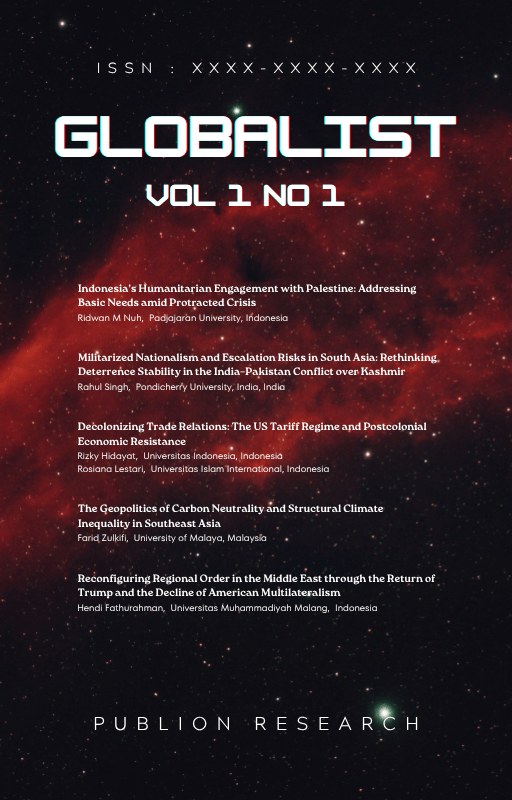
The Geopolitics of Carbon Neutrality and Structural Climate Inequality in Southeast Asia
DOI:
https://doi.org/10.7080/yaetkq84Abstract
This paper analyzes Southeast Asia’s carbon neutrality agenda within the context of structural inequality and global power asymmetry. While carbon neutrality is framed as a universal scientific goal, it operates through governance frameworks largely shaped by the interests of powerful states and institutions. Southeast Asian countries, despite their relatively low historical emissions, are expected to adopt externally defined timelines, technologies, and policy standards that often do not reflect their domestic realities. Using a political economy approach, this paper examines how instruments such as climate finance, carbon markets, and international transition partnerships function not as neutral tools, but as mechanisms that entrench dependency and limit sovereign climate planning. Through case studies of Indonesia and Vietnam, and an assessment of regional climate diplomacy, the paper reveals how foreign funding often comes with conditionalities tied to policy reforms, market restructuring, and external oversight. Rather than empowering national institutions, climate cooperation frequently bypasses local actors and inserts international frameworks into domestic governance. The analysis also interrogates how Southeast Asia’s geopolitical position intensifies these constraints, as governments are caught between the strategic agendas of major powers while lacking collective bargaining strength. Ultimately, the paper calls for a redefinition of climate justice from the Global South—one that emphasizes historical responsibility, political autonomy, and context driven transition pathways. Carbon neutrality, if it is to be just, must not reproduce global hierarchies in new forms. By situating Southeast Asia’s climate policy within a postcolonial critique, this paper offers an alternative lens for understanding and reshaping global climate governance.
Downloads
References
Alam, M. M., Aktar, M. A., Idris, N. D. M., & Al-Amin, A. Q. (2023). World energy economics and geopolitics amid COVID-19 and post-COVID-19 policy direction. In World Development Sustainability (Vol. 2). https://doi.org/10.1016/j.wds.2023.100048
Asongu, S., Akpan, U. S., & Isihak, S. R. (2018). Determinants of foreign direct investment in fast-growing economies: evidence from the BRICS and MINT countries. Financial Innovation, 4(1). https://doi.org/10.1186/s40854-018-0114-0
Blondeel, M., Bradshaw, M. J., Bridge, G., & Kuzemko, C. (2021). The geopolitics of energy system transformation: A review. Geography Compass, 15(7). https://doi.org/10.1111/gec3.12580
Boa Morte, I. B., Araújo, O. de Q. F., Morgado, C. R. V., & de Medeiros, J. L. (2023). Electrification and decarbonization: a critical review of interconnected sectors, policies, and sustainable development goals. Energy Storage and Saving, 2(4). https://doi.org/10.1016/j.enss.2023.08.004
Boyce, G. A., Launius, S., Williams, J., & Miller, T. (2020). Alter-geopolitics and the feminist challenge to the securitization of climate policy. Gender, Place and Culture, 27(3). https://doi.org/10.1080/0966369X.2019.1620698
Chandra Voumik, L., & Sultana, T. (2022). Impact of urbanization, industrialization, electrification and renewable energy on the environment in BRICS: fresh evidence from novel CS-ARDL model. Heliyon, 8(11). https://doi.org/10.1016/j.heliyon.2022.e11457
Couwenberg, J., Dommain, R., & Joosten, H. (2010). Greenhouse gas fluxes from tropical peatlands in south-east Asia. Global Change Biology, 16(6). https://doi.org/10.1111/j.1365-2486.2009.02016.x
Dalby, S. (2013). The geopolitics of climate change. Political Geography, 37. https://doi.org/10.1016/j.polgeo.2013.09.004
Ehrenstein, V. (2018). Carbon sink geopolitics. Economy and Society, 47(1). https://doi.org/10.1080/03085147.2018.1445569
Eicke, L., & De Blasio, N. (2022). Green hydrogen value chains in the industrial sector—Geopolitical and market implications. Energy Research and Social Science, 93. https://doi.org/10.1016/j.erss.2022.102847
Hancock, L., & Wollersheim, L. (2021). Eu carbon diplomacy: Assessing hydrogen security and policy impact in australia and germany. Energies, 14(23). https://doi.org/10.3390/en14238103
Huang, J. (2024). Resources, innovation, globalization, and green growth: The BRICS financial development strategy. Geoscience Frontiers, 15(2). https://doi.org/10.1016/j.gsf.2023.101741
IRENA. (2023). Geopolitics of the Energy Transition: Critical Materials. In Journal of Geographical Sciences (Vol. 33, Issue 4).
McLaughlin, H., Littlefield, A. A., Menefee, M., Kinzer, A., Hull, T., Sovacool, B. K., Bazilian, M. D., Kim, J., & Griffiths, S. (2023). Carbon capture utilization and storage in review: Sociotechnical implications for a carbon reliant world. In Renewable and Sustainable Energy Reviews (Vol. 177). https://doi.org/10.1016/j.rser.2023.113215
Oberthür, S. (2016). Where to go from Paris? The European Union in climate geopolitics. Global Affairs, 2(2). https://doi.org/10.1080/23340460.2016.1166332
Paltsev, S. (2016). The complicated geopolitics of renewable energy. Bulletin of the Atomic Scientists, 72(6). https://doi.org/10.1080/00963402.2016.1240476
Pflugmann, F., & De Blasio, N. (2020). The geopolitics of renewable hydrogen in low-carbon energy markets. Geopolitics, History, and International Relations, 12(1). https://doi.org/10.22381/GHIR12120201
Ramachandran, S., Rupakheti, M., Cherian, R., & Lawrence, M. G. (2022). Climate Benefits of Cleaner Energy Transitions in East and South Asia Through Black Carbon Reduction. Frontiers in Environmental Science, 10. https://doi.org/10.3389/fenvs.2022.842319
Sovacool, B. K., Baum, C., & Low, S. (2023). The next climate war? Statecraft, security, and weaponization in the geopolitics of a low-carbon future. Energy Strategy Reviews, 45. https://doi.org/10.1016/j.esr.2022.101031
Srivastava, N., & Kumar, A. (2022). Minerals and energy interface in energy transition pathways: A systematic and comprehensive review. In Journal of Cleaner Production (Vol. 376). https://doi.org/10.1016/j.jclepro.2022.134354
Stoddard, I., Anderson, K., Capstick, S., Carton, W., Depledge, J., Facer, K., Gough, C., Hache, F., Hoolohan, C., Hultman, M., Hällström, N., Kartha, S., Klinsky, S., Kuchler, M., Lövbrand, E., Nasiritousi, N., Newell, P., Peters, G. P., Sokona, Y., … Williams, M. (2021). Three Decades of Climate Mitigation: Why Haven’t We Bent the Global Emissions Curve? In Annual Review of Environment and Resources (Vol. 46). https://doi.org/10.1146/annurev-environ-012220-011104
Tahir, M., & Burki, U. (2023). Entrepreneurship and economic growth: Evidence from the emerging BRICS economies. Journal of Open Innovation: Technology, Market, and Complexity, 9(2). https://doi.org/10.1016/j.joitmc.2023.100088
Theiventhran, G. M. N. (2024). Energy as a geopolitical battleground in Sri Lanka. Asian Geographer, 41(1). https://doi.org/10.1080/10225706.2022.2098507
Topalidis, G. T., Kartalis, N. N., Velentzas, J. R., & Sidiropoulou, C. G. (2024). New Developments in Geopolitics: A Reassessment of Theories after 2023. Social Sciences, 13(2). https://doi.org/10.3390/socsci13020109
Ulloa, A. (2017). The geopolitics of carbonized nature and the zero carbon citizen. In South Atlantic Quarterly (Vol. 116, Issue 1). https://doi.org/10.1215/00382876-3749359
Yang, Y., Xia, S., & Jin, Z. (2023). Energy transition reshapes geopolitics: Logic and research frontiers. Dili Xuebao/Acta Geographica Sinica, 78(9). https://doi.org/10.11821/dlxb202309012
Yang, Y., Xia, S., & Qian, X. (2022). Geopolitics of the energy transition. Dili Xuebao/Acta Geographica Sinica, 77(8). https://doi.org/10.11821/dlxb202208014
Yang, Y., Xia, S., & Qian, X. (2023). Geopolitics of the energy transition. Journal of Geographical Sciences, 33(4). https://doi.org/10.1007/s11442-023-2101-2
Yuan, X., Su, C. W., Umar, M., Shao, X., & LOBONŢ, O. R. (2022). The race to zero emissions: Can renewable energy be the path to carbon neutrality? Journal of Environmental Management, 308. https://doi.org/10.1016/j.jenvman.2022.114648
Zhang, L., & Ponomarenko, T. (2023). Directions for Sustainable Development of China’s Coal Industry in the Post-Epidemic Era. Sustainability (Switzerland), 15(8). https://doi.org/10.3390/su15086518
Downloads
Published
Issue
Section
License
Copyright (c) 2025 Globalis: Journal of Global and Regional Politics

This work is licensed under a Creative Commons Attribution-ShareAlike 4.0 International License.